
In the sunny coastal countryside a few miles from the town of Knokke, Belgium, the Omloop family manor sits quite at odds with its surroundings. A dark post-Gothic construction spanning six acres, it has long been widely regarded as a blight on the landscape, known locally by its perennial nickname Het Spinnenhuis, or the Spider House, for its distant resemblance to an enormous black tarantula lurking among the polders.
A tourist could be forgiven for thinking the place uninhabited, given its present dereliction. But there is not a child in Knokke not taught from a very young age that they must never go near the Spider House under any circumstances; for here there once resided the Countess Renée Clémentine De Spiegeleer Omloop, second cousin once removed to the erstwhile King Leopold II of Belgium, and much like her famous relative, a fine example of the ancient adage that wealth breeds only corruption. Yes, the Countess lived here once, and depending on who you might ask, she never truly left.
To be clear, while my own cousin may be a man of certain means, our family never has and I daresay never will reach quite the heights of social strata necessary to be brushing noble elbows with viscounts, duchesses, or the like. Rather, this account of the Countess Omloop is derived in typical roundabout fashion via Marvin’s years with his onetime fiancée Agneta, and more specifically his cherished friendship with her mother Johanna, herself a deeply spiritual woman and an avid spinner of ghost stories in her own right.
To Johanna, the mystical superstitions instilled in her Nordic upbringing were as fundamental as any fact of science, if not more so. She never moved more quickly than when rushing to remove a set of keys carelessly left upon a dining table, was pathologically averse to the presence of heather, and even carried a sliver of pinewood everywhere she went just in case she needed to knock on it three times for luck, uttering at once the ever-present motto ‘syv-ni-tretten’, which, though his engagement with Agneta long since went up in smoke, Marvin is still wont to imitate at times, in moments of nostalgia.
Yet some people do change. In her youth, Johanna had been a wayfaring rover, a habitual traveller and outright thrillseeker, in fact, and as brashly sceptical as any girl her age when it came to matters of the paranormal. This was evident from many of her stories; apparently some event in her young adulthood had caused her to rethink her disbelief. When Marvin asked to hear about it one day, a familiar twinkle came into Johanna’s eye as she leaned back in her armchair and agreed to recollect the occasion some thirty years prior, when she had been passing through the town of Knokke in considerable need of some cash, and heard about a vacancy at the Omloop family manor.
In those days, most of the local townsfolk did their best not to acknowledge the place at all, except when indulging to partake in the kind of gossip which inevitably circulates so grim a landmark, which held, naturally, that even if the reclusive Countess was not some combination of witch, vampire, or succubus in the strictly literal sense, then she must surely be so in spirit.
But the town was small, and the Omloop fortune large enough that for an intrepid young lady far from home and travelling the region, a season of work at the Spider House was not such an undesirable thing. Knowing little of the manor’s sinister reputation, and minding it even less, Johanna was thrilled to find herself in such a grand abode and eager to know just how a woman as wealthy as the Countess might actually spend her days.
It did not take long for her to find, however, that few among the staff knew any more of the subject than she did. Most, like Johanna, were foreigners and wanderers new to the area, some knowing hardly any Dutch or French at all. Save for the butler and the lady’s maid, hardly anyone interacted with or even saw their elusive employer with any regularity.
The woman was a compulsive collector, that much was immediately obvious, for of the house’s thirty-nine rooms, the only ones not filled with diverse artefacts on show, or equally, with countless boxes and crates of the same in a perpetual state of reorganisation, were the kitchens and the servants’ quarters in the attic. Indeed, many of the workers’ primary responsibilities involved the processing of freshly acquired pieces shipped from overseas, with the Countess keeping representatives at many high profile auction houses all over the world and making on average at least one extravagant new purchase per week. But this was, apparently, the extent of available insight into her character.
As a housemaid, Johanna was charged with the weekly upkeep of a dozen rooms on the house’s first floor, each containing a plethora of treasures loosely archived by societal and historical origin. It being wintertime, maintaining the fireplaces was a chief concern, and hence she was constantly going back and forth between the many rooms. Soon she had become very familiar with not only that cross-section of the manor, but of the Countess’s vast and strange collection.
Much of it was the kind of thing one might expect to find adorning a stately home: items of weaponry, armament, and related wartime ephemera, especially knives, swords, spears, clubs, and axes of endless different designs, as well as articles of armor and military dress, some complete, many only fragments.
There were also dozens of animal skeletons, pelts, furs, and taxidermied specimens of vicious predatory beasts immortalised in frozen attack poses. Among these there were, funnily enough, at least two large cases of venomous spiders varying in species, shape, and size, pinned and mounted for inspection as if in a museum.
But apart from these were foreign devices, tools, and machinery of which Johanna could not tell the intact examples from the mere pieces, nor indeed recognise much of it at all. Some had distinctive parts like chains, straps, or clasps which gave some clues to their intended use, but others were more abstract. One room seemed almost solely decorated with great spoked wooden wheels each roughly the size of a person, though what manner of ancient vehicle they could have possibly belonged to, young Johanna had no clue. Another was full of all sorts of strangely designed tables, chairs, and beds which looked terribly unfit for purpose; a third, packed with cauldrons, pots, and ovens, including, oddly enough, one shaped to resemble an enormous bronze bull. Johanna could not articulate the reason, but this never failed to strike her with a most unwelcome feeling.
But the strangest display of all was also the most mundane. When moving between the eastern and western wings of the manor, Johanna would need to pass through the gallery above the main hall at the top of the central staircase, where a single tall glass cabinet spanned the whole width of the landing. Contained within were all sorts of different objects alike in only one respect: each had been constructed using copious amounts of animal skin. There was furniture, hats, boots, purses and satchels, cases, trunks, books, even musical instruments, all seemingly various in cultural style and origin except for appearing crudely handmade, gnarled and ancient looking, and generally hideous to Johanna’s eyes.
On her first day she had spent an especially long time examining this selection, hypnotised by bafflement as to why anybody would want to own any of it, much less display it so prominently. But as tends to happen in one’s workplace, even this question soon became a mere backdrop to Johanna’s daily routine, and quite immune from her attention for the next couple of weeks.
Commencing her duties one chilly morning, Johanna was heading upstairs to the first floor landing only to be met with a group of unfamiliar workers blocking her way. They had opened up the long glass cabinet and were, she saw, carefully reordering the display within to make way for a new addition, presumably the contents of the large crate, covered in postage stamps and warning labels, which several were working over with crowbars. She was trying to peer through the crowd to get a look at the thing when a new surprise caused Johanna’s jaw to drop: stood directly to her left was the Countess herself, leaning impatiently against the balcony at the opposite side of the gallery with her arms folded, and barking intermittent directions at the goings-on.
Of course Johanna had glimpsed her employer occasionally, but only briefly, while in passing, and never in such proximity. Up close, it was shocking to realise how youthful the Countess appeared, and beautiful, in spite of her current harsh expression. When the crate finally opened with a powerful crack, the frown she wore gave way to a broad, flashing smile, instantly doubling her beauty, so much so that Johanna could not help but stare.
Perhaps sensing the eyes watching her (and the only pair present which were not peering into the newly opened crate) the Countess cast a sudden sharp glance to her observer which caused Johanna to flee at once for the next room, feeling like a naughty child. Having become so used to the monotony of her role, Johanna found the whole scene strangely unnerving, and was equally relieved to be once again alone but for the bizarre exhibitions all around her.
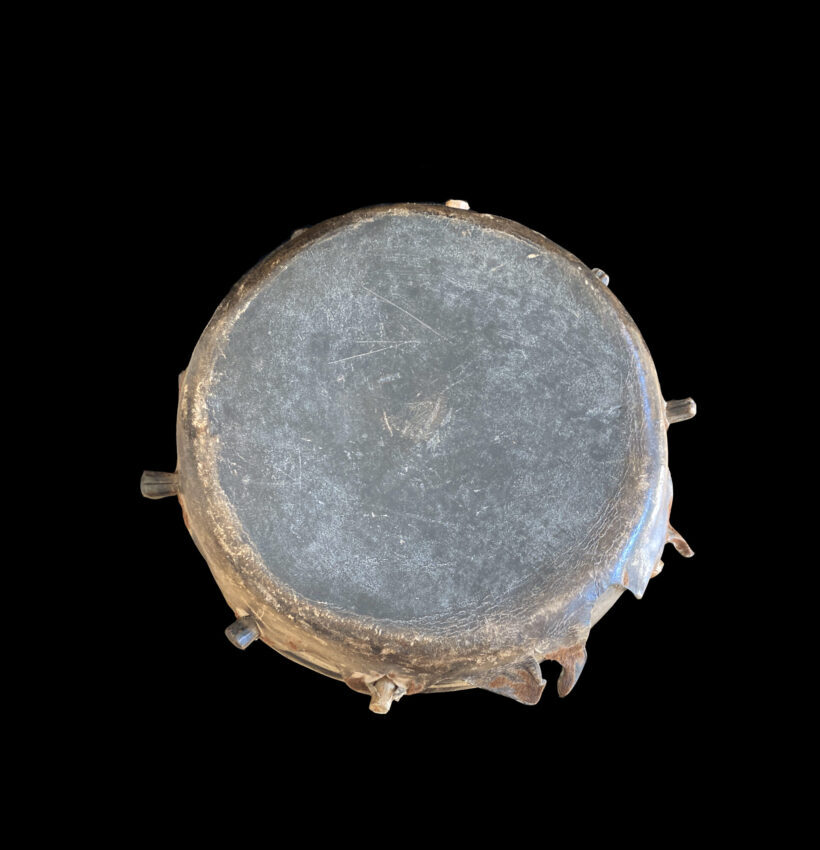
Later, she had her chance to see the reason for the commotion, free from any scrutiny. The new centrepiece in the landing cabinet appeared, somewhat disappointingly, to be a perfectly typical tribal drum, its narrow, conical body about four feet tall and plainly repurposed from a medium-sized tree trunk. Its only obvious congruence with the rest of the display was, in keeping with the cabinet’s grotesque theme, that the drumhead was made of some kind of animal skin, rawhide, naturally, stretched taut and fitted in place with several wooden pegs. Otherwise, Johanna could find no discernible indicators of the item’s significance at all.
But after gazing at it for a while, something finally clicked in her understanding.
Though well-traveled in Northern Europe, Johanna had never left her home continent, and could only estimate by the drum’s similarity to examples she had seen in books and museums that it was likely African in origin. Later in life, she would confirm that it most strongly resembled a ngoma, a creation of the Bantu people native to much of central Africa. She knew by common knowledge of the Countess’s relation to King Leopold II, but even if she hadn’t, the manor was decorated with enough royal portraits and paraphernalia to make it clear. And of course, the sordid history of that monarch’s private ownership and relentless abuses of his so-called Congo Free State was by then a matter of international infamy.
Johanna recalled an article she had once read about an incident in which the Openbare Weermacht, the state’s alleged military, had killed, dismembered, and cannibalised a five-year-old girl by way of reprimanding the village for insufficient quantities of rubber production. They had come to collect the rubber three days earlier than agreed. The article said it was only one example from a list of hundreds, if not thousands of similar cases of astonishing corruption, the true number being impossible to determine given Leopold’s order to burn the state’s entire archive in anticipation of its annexation by the Belgian government. Johanna had never forgotten the accompanying photograph, which showed the little girl’s father sitting on a veranda, staring at his daughter’s severed hand and foot.
Now Johanna was staring at the drum as all these thoughts and more swam through her mind, until she could no longer deny the horrifying prospect at which they all seemed to be pointing. Did the skin drawn tightly across the drumhead not look a little thinner than one might expect for such a purpose? Did its dark brown colour not seem a touch richer than the yellow-grey of most drumskin? Was it not strangely bald, where typical animal hides might show a few patchy remnants of fur?
Quickly she scanned the rest of the display, looking to the artefacts of rawhide rather than tanned leather: the whip, the lampshade, the saddle, the flimsy-looking boots. None had any fur at all. Finally Johanna decided that there was, perhaps, a faded, fuzzy layer of hair lining one part of the topmost section of the saddle, but to her mind it did not look as though it had come from an animal at all. That is, it looked as though it had come from one particular species of animal whose very membership in the category is often overlooked.
Johanna could not say how long she stood before that cabinet window, not wishing to believe her own eyes; at any rate, her stupor was ultimately disturbed by the appearance of one of her fellow servants, a newer recruit begging to know if she would help with something downstairs. But just as Johanna pulled herself away, obliging, she spotted a dim reflection in the glass which bore the distinct likeness of a figure lingering at the balcony of the gallery above. She turned just in time to see the Countess draw back, stealing into the shadows.
Sleep refused Johanna that night. In the light of her newfound suspicion, every one of the vast catalogue of unplaceable objects which filled the manor had taken on a horrible new meaning, and between the snoring of the kitchen maid in the next bed, and the rattling of the shutters in the winter wind, she spent hours doing nothing but staring into the black void of the ceiling, her thoughts awash with images returning from all the dusty corners of her memory.
Here was a volume of European history plucked from her parents’ bookshelf as a child, where a medieval illustration of broken bodies impaled upon great wheels had given her nightmares forgotten for decades, until now. Here was a fairy tale from her grandmother, that of Bluebeard, who hung the corpses of his murdered wives from hooks on the ceiling in his secret chamber, flooding its floor with blood. Here was a campfire story passed around the schoolyard which told of an island in the middle of the ocean whose inhabitants would spear shipwrecked sailors on sight for dinner, and make boatsails from their skins. Dreadful, unshakeable imaginings plagued her all night long, of severed limbs, howling parents, greedy kings, and all the innumerable senseless cruelties of the whole bloody human crusade.
When finally she had had enough, Johanna gave up all attempts to rest, lit a little candle by the bedside, and tried to otherwise distract herself. Daytime was still some hours away, and since a nightly walk about the manor was hardly an appealing prospect, she decided to write a letter home to her family, an activity which never failed to warm her heart and order her thoughts. Of course, Johanna had no intention of informing her sweet parents of what was truly on her mind – that their daughter had wound up in the employment of, at best, a covetous and deviant necrophile – and so intended to make up something more pleasant, and perhaps even use the exercise to help herself come up with a way of absconding her position at the manor earlier than expected.
Johanna was not five minutes into her task when she began to be aware of a sound: a dull and rhythmic thudding which she took at first for her own heartbeat, expanded surrealistically to an impossible breadth of volume and seeming to drift up from below the attic floorboards. Now that she could really hear it, she felt eerily certain the sound had been there all along, that the ambient noises of the sleeping quarters had only obscured it, that it was, in fact, what had truly been keeping her awake.
Setting down her paper and pencil very gradually, being careful not to make any unnecessary noises of her own, Johanna attempted to focus her nervous attention and pinpoint the sound’s precise location in the house. Yet in her heart she already knew the answer. Two floors down and one wing over, somewhere around the first floor gallery, something was playing a soft but steadily percussive beat of unyielding quarter notes going round and around again, each measure punctuated by a final emphatic pop: one-two-three-FOUR one-two-three-FOUR one-two-three-FOUR one-two-three-FOUR.
We may commend her for her courage in what she did next, but when recounting the story, Johanna was keen to express that terror had been her only motive; a desperate terror to prove that she wasn’t going mad, that if she did not go and confirm for herself that someone or something really was banging on that drum downstairs, then she would never again be able to trust her own senses.
Clad in her nightdress with the bedspread wrapped around her like a cloak, she took the little candle and quietly left the servants’ quarters, unaware until her bare feet met the frigid attic steps that she had forgotten her slippers. But then, not knowing what she might be walking into, a silent approach did seem wise.
Once outside the attic, the drumming was unmistakable, scoring Johanna’s movements as she navigated the hallways to the second floor gallery. Though she knew where she was going despite the pitiful glow of the candle, she could in any case have simply followed the music. As she neared its source, the beating swelled tremendously, echoing through the walls like some absurd private fanfare; now she began to perceive a human voice also speaking beneath it in low muttering tones, indecipherable at this distance, but decidedly feminine.
Arriving at the upper balcony, Johanna was quick to hide her candle flame, remembering the reflection she had spotted earlier, cast from the very same position where she now stood. But the darkness didn’t matter, for in the gallery below, the light of the Countess’s own candelabra was strong enough to render the scene all too vivid.
Directly before the great glass cabinet where the drum had been installed, the Countess Omloop was writhing on her knees, rocking back and forth to its pounding beat, her petticoat sprawled against the floor like a blooming, black flower, her long dark hair loose and tousled, tossing all about her head. In the heavy play of the candlelight, with all shadows extremified, her movements recalled a panicked, long-legged spider, or perhaps, the spasms of a fly caught in its web. The words and utterances leaving her mouth seemed equal parts rapturous and hysterical; some might have been laughter, others shrieks of horror.
Disturbing as it was, still Johanna found herself less concerned with what the Countess appeared to be doing as with what she was most certainly wasn’t, for she was not playing the drum; nobody was playing the drum, the drum was playing itself, playing the part of its own master, emanating its own aggressive pulse through sheer force of its own inhuman will, with inhuman precision, and inhuman patience, and somehow, though it defied all logic for Johanna to acknowledge, the most palpable sense of underlying rage: one-two-three-FOUR one-two-three-FOUR one-two-three-FOUR one-two-three-FOUR.
With each passing second, a violent tug-of-war was taking place within her mind. At once she understood that she had stumbled upon something unspeakably foul, blasphemous even to a sceptic – or perhaps especially to a sceptic – yet her role also felt predestined, as if bearing innocent witness to this unholy ceremony was now her solemn obligation, and daring to so much as look away would surely damn her soul.
The drumbeat grew louder and louder, every beat a punching volley, and just when Johanna thought that she could take no more, the Countess contorted backwards and whipped her head around towards the upper gallery, a look of abject fury on her face.
Johanna’s feet flew so quickly back to the attic that the wind swept her candle out, and it was only after having scampered up the steps, huddled beneath the pitch black of the bedspread over her head ,with her hands clamped against her ears, that the pounding finally relented, drowned out by the roar of her own ragged breathing, and the frantic kicking of her heart, until at last sleep swallowed everything.
When she woke the next morning, numb with exhaustion, Johanna’s sole intention was to pack her scant belongings and flee the entire region at the most immediate opportunity. Yet the manor had other plans. Within minutes the head housemaid had gathered everyone together to relay the sad news from the lady’s maid. It seemed that overnight, the Countess had fallen severely ill, and alterations of everyone’s work schedule were required in order to accommodate her care. Before she knew it, Johanna was being enlisted with two other maids to travel into Knokke and procure various medicines from the local druggist, among other emergency supplies.
Immersed all of a sudden in the stark normalcy of the town, and hearing her colleagues’ small talk as they ran their appointed errands, Johanna could not help but doubt her experience of the night before. It occurred to her that she had no way of proving the whole thing had not been some awfully convincing dream. And even if it had happened, none of it was definitely supernatural. Who was to say there hadn’t been some other party, positioned just out of Johanna’s sight, playing a different drum altogether? Or, that the drumming hadn’t come from the Countess herself, slamming her feet against the floor? Or the wind, hitting a nearby window of the manor in such a way as to create the impression of rhythm, a kind of auditory illusion?
The Countess was sick; that much was sheer fact. In all likelihood Johanna had walked in on her at the condition’s onset, some kind of medical episode, a paroxysm of the nerves. Whatever the case, there were far too many rational explanations to justify leaping to any paranormal alternatives. It should have been a more comforting thought.
When the maids returned, the manor was abuzz with doctors and paramedical staff, and so it remained for the next three days and nights. Each day the Countess’s prognosis grew ever bleaker, and with none but the doctors and the lady’s maid permitted in her room for fear of any potential contagion, rumours of her worsening state were spreading equally among the servants. It seemed that no one knew exactly what the problem was, but evidently some variety of wasting disease. She would not take food or drink, and was rapidly losing weight. Each time the lady’s maid emerged from her mistress’s bedroom, she looked more pallid, and on the evening of the third day she was outright inconsolable, collapsing into tears and refusing to elaborate to anyone.
For Johanna, the prospect of quitting her post became ever less feasible. Not only was the season’s end fast approaching, and good references – not to mention final salary – mattered to a habitual traveler, but she was also not one to so easily abandon a charge in need, regardless of that individual’s unseemly collecting habits. And whatever had really passed between herself and the Countess on that strange night, the experience had left Johanna feeling a kind of grim kinship with her mistress. It seemed only right that she should remain in the manor at least until the end of her contract, and see the thing out to its conclusion. Of course, she could also not deny that plain old curiosity played no small part in her thinking.
As regards the drum, Johanna had come to the crudely logical conclusion that since what she thought she’d observed was quite impossible, she must not have observed it at all. Even so, she was privately grateful that her new duties for the most part had her working elsewhere in the manor, and still took pains to avoid being near the first floor gallery at all.
By the fourth evening, the doctors had decided that the Countess was probably suffering from an exceedingly rare inherited disease whose symptoms had hitherto been dormant, and was therefore uninfectious. Simultaneously it was agreed that the lady’s maid was no longer in any fit state to perform her duties. Some speculated, despite the doctors’ claim, that she must have caught the Countess’s illness, for she seemed terribly stricken in her own right and near delirious with fright at the prospect of having to reenter her lady’s bedroom.
Consequently the housemaids were organised into a rota to help manage the Countess’s palliative care in shifts, in assistance to the nurses and on-call doctor. Whether by diabolic intervention or blind dumb luck, the first name chosen from the list was Johanna’s, who reacted to the news with a hollow dread.
Her first task was to bring up supper, a somewhat empty gesture as everybody knew the Countess had been refusing practically all food, but important nonetheless. Johanna had never seen the bedroom’s interior before, and was not eager to become acquainted with it now. Standing before the door with the supper tray in one hand, Johanna found herself knocking four times in an odd rhythm: tap-tap-tap-TAP, before entering. At once the stench enveloped her, the stuffy, acrid hue of stale sickness, blood, and waste. Yet it provoked a stalwart sympathy in Johanna, for if she did not help this poor woman, whoever would?
The curtains drawn closed around the grand canopy bed told her that the Countess was resting, the brittle hissing sensation coming from within presumably her sleeping breath. Permitting herself some small gratitude for the fact, Johanna carefully set the supper tray down at the bedside table, and sighed with sad fatigue.
Somehow it struck her as no surprise to turn and see that the large glass cabinet on the main wall directly opposite the bed contained seven full human skeletons, each dressed in gaudy, costume-like attire, and mounted in a sequence of naturalistic poses. Unlike with most of the manor’s exhibits, this one was labeled with small embossed plaques below each specimen, presumably conveying the names of the deceased. Grimacing, Johanna leaned in to get a better look, but found that she knew none of them.
“E-ne-miesss,” the Countess rasped. “E-ne-miesss-of-the-crrrown…”
No description can do justice to the voice which came from the canopy bed. It was a sound like the rending of split wood, a splintered, guttural, creaking tear, as if the very air of the room itself was being ruptured. The effect was sufficient to freeze Johanna where she stood, bent towards the skeleton case, her thoughts reeling to imagine the face which could have possibly produced such speech.
“Mmmiiine-nowww… mmmiiine-in-deathhh…”
Something like a haughty arrogance lay beneath the breathless groaning. Reflected in the display glass, Johanna watched the curtains directly behind her rustling, as if resisting an attempt by weak hands to draw them open from within.
“Helppp-me-girrrl…cccome-hhhelppp-yourrr-lady…”
The fear was like a pendulum in her gut. She could feel it insisting that she move towards the door, away from the manor, away from the town, damn her belongings, damn her salary, freedom from this godforsaken place was all in the world that mattered now. Still Johanna’s feet were glued to the floor; still there was some saintly part of her imploring that the Countess was only a very sick woman, a very sick woman who needed her help, that if she were to run right now, she herself would be the only monster. Johanna could hardly believe it when she felt herself begin to walk again, not towards the door, but to the bedside, her voice even uttering gentle words of comfort to the Countess as she raised her hands to part the curtains.
But it was a lie. This was no sick woman – this was no longer a woman at all, but a gaunt and lanky construction of wood, and pegs, and papery white skin stretched taut across a mocking skeletal frame. Beneath its drum-like breast, the creature’s feeble heart was visibly quivering, its glassy eyes rolling madly about their shallow sockets. This was a man-sized marionette brought to abominable life, straining against its own every movement with the wincing grinding of empty wood against wood.
At the sight of Johanna, the thing now seemed to grimace, the tight flesh of its face peeling back from the crude hole which stood for its mouth to bare brown, peglike teeth, squirming with termites.
“You-!-You-you-werrre-therrre-!-You-you-wwwaaatchhhed-it…you-wwwaatchhhed-it-hhhappennn… e-ne-miiies…e-ne-miiies-everrrywherrre-!”
Louder than her own terrible screams, Johanna could hear the drum beating again at a furious pace, as loud as if it was in the room, as if it was in her very soul. The very walls seemed to shake with it. It beat and beat and beat until the thing that was the Countess rasped and cried and danced its grotesque dance no more.
Today, the lady of the manor is buried on its grounds. Not far, in the adjacent countryside, a mass grave is filled with the two dozen or so items from her collection in which investigators detected unidentified human remains. The rest was ostentatiously auctioned off by others in the Omloop dynasty, attracting international attention for the many rare and macabre curiosities. Some pieces found their way back to the museums and communities from which the Countess had originally acquired them, often through allegedly dubious means. Others simply disappeared without a trace, lost perhaps to looters, light-fingered staff, graverobbers. Which of these fates describes the drum is still a mystery; Johanna could never find a single record of it.
Later in life, she reached satisfaction in her own conclusions. The Norse myths make clear the dangers of denying a body its proper burial rites, after all; look to the draugr, or the haugbúi, and remember well their worldly lessons. And one only has to ask the girls and boys of Knokke to learn the many local tales and rumours of strange music heard from deep within the manor’s lifeless premises. Some say that when the drumbeat plays, the thing that was the Countess cannot help but rise again in agony to guard her ill-gotten treasures, forever enslaved to that fell rhythm, condemned to the very restlessness she imposed on so many others.
Whether noble or servant, this much must be true: whenever one takes another’s body as mere property, there are always the gravest consequences; the drums of death beat for us all.